In this article
You had picked a background, written a little about yourself and added some favourite links. Perhaps there was a photograph of the dog, or a page about your collection. Your homepage was ready. But was anyone actually looking?
A hit counter offered an answer. Not to every question, and not always a very accurate one, but to the most important question: something was happening on your site. Yesterday it read 326. Today it read 327.
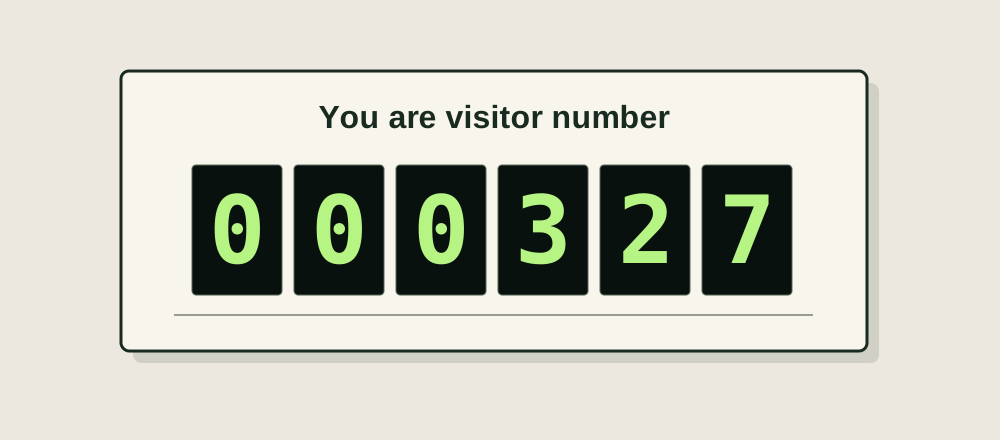
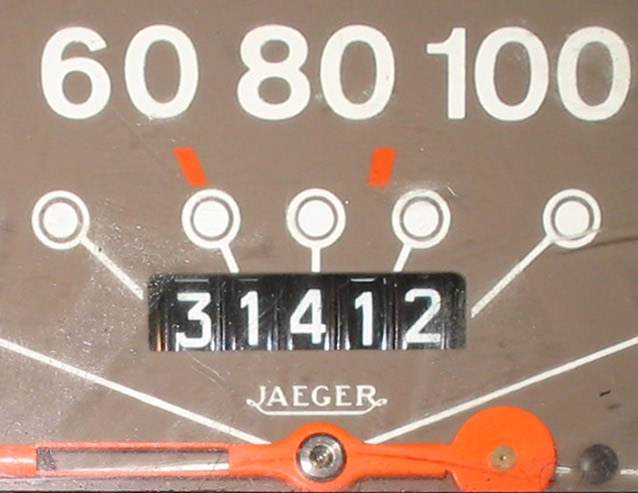
An odometer for your homepage
From the mid-1990s, visible counters became a familiar feature of the web. They suited an era when a personal homepage really felt like a place of your own. You furnished it, put up a welcome message and showed visitors how much company you had received.
The designs varied. Some were plain numbers in ordinary text; others resembled a digital clock or a mechanical counter. Leading zeros were part of the appeal: 000327 looked as if the site had plenty of room for an impressive future.
Beside the counter you often found other homepage fixtures: a guestbook, an email link and the date of the last update. Together, they told you something about the person who lived in this little corner of the internet. Someone was working on it. You were welcome to look around and leave a message.

Someone has seen my page
For a business, traffic could have commercial value. For a hobbyist, it was mostly attention. You had written about your favourite band, posted photographs of model trains or put together a guide. A rising number suggested that the effort was reaching someone.
The counter usually did not tell you who had visited. A friend? Someone arriving through a search engine? A stranger on the other side of the world? That invisible audience was part of the excitement.
A guestbook made visits more personal. Someone could say they liked the site, ask a question or recommend their own homepage. The counter showed that there was activity; the guestbook could reveal who was behind some of it.
The thousandth visitor
Round numbers turned ordinary traffic into an occasion. The hundredth, thousandth or ten-thousandth visitor was a milestone. A personal homepage might carry a request: if you are number 1,000, send me an email.
The counter became a little game between the owner and the audience. Perhaps someone took a screenshot of the special number. Perhaps the owner checked at just the right moment and watched it change.
The scene is easy to imagine: the homepage is open, the number is approaching its target and the temptation to press refresh again keeps growing.
But that brings us to the question hidden behind all those digits. What was the counter actually counting?
Visits were not visitors
The label ‘You are visitor number’ promised more certainty than many simple counters could provide. They might count how often a page or a counter image was requested. That was different from the number of individual people visiting a website.
One person could return and be counted again. The owner could open the page to check an update. Depending on how the counter worked, refreshing could also increase the total. Conversely, cached copies could mean that not every display generated a new request.
The word hit was confusing too. In server statistics, a hit could mean a request for a single file. A page containing several images could therefore generate several hits. A simple counter counting only requests for its own image worked differently again. Hits, page views and unique visitors were not interchangeable measures.
A high total did not tell you whether anyone had read the story. A visitor might leave immediately, or stay for a long time without opening another page. The same increase of one could hide a very different experience.
A little picture with a server behind it
A counter looked like an image, but its number had to be stored somewhere. That happened on a server. A program read the saved total, increased it according to its counting rules and returned the result as text or as an image.
One concrete example is the Counter script from Matt's Script Archive. Version 1.1.1, described on its documentation page, was released on 11 January 1996. The explanation immediately made an important qualification: more precisely, the script counted the loading of the counter image.
If you could not install your own counter script, you could use an external service. You added a snippet of code to your homepage, and the service supplied the counter. This made installation easy, but also created a dependency. If the service became unavailable, a missing-image symbol could appear in place of the digits.
From public counters to statistics behind the scenes
Server logs and more detailed statistics also existed alongside the visible counter. As website owners wanted to know more, a single running total became less useful.
Which pages were people viewing? Which links brought them in? Did they return? Those questions required more information than a counter at the bottom of the homepage could provide.
The presentation of websites changed too. On many sites, the public counter disappeared while the owner continued to monitor traffic behind the scenes. The audience no longer needed to see the numbers.
The desire for visible attention did not disappear. View counts, follower totals and likes play a related role in other settings. They make reach visible and invite comparison. In that respect, the old hit counter feels surprisingly familiar.
One more stranger
The appeal of the hit counter was not just measurement. It made an invisible audience a little more tangible. Someone had found your address, clicked a link and opened the page you had been working on the night before.
Perhaps the number was inaccurate. Perhaps you accounted for a sizeable part of it yourself. Even so, one extra digit could bring pleasure.
From 000326 to 000327. Someone had stopped by. Probably.
Sources and further reading
Matt's Script Archive — Counter ↗Carolin Gerlitz & Anne Helmond — The Like economy (2011) ↗