In this article
Perhaps your first email address arrived on paper. Among the details for your internet connection were a username, a password and the settings for collecting your mail. You had to type them carefully. One wrong character and nothing happened.
Then you sent a message to someone else who already had internet access.
This is my new email address. Did this arrive?
The answer might have been just as short: Yes, it works!
Something had changed. You now had a place where messages could reach you, without an envelope, a stamp or a trip to the letterbox. You just had to turn on the computer and, in the dial-up years, connect first.
This story looks at that experience from a Dutch perspective, through the provider addresses that became part of everyday life in the Netherlands.

Your provider came after your name
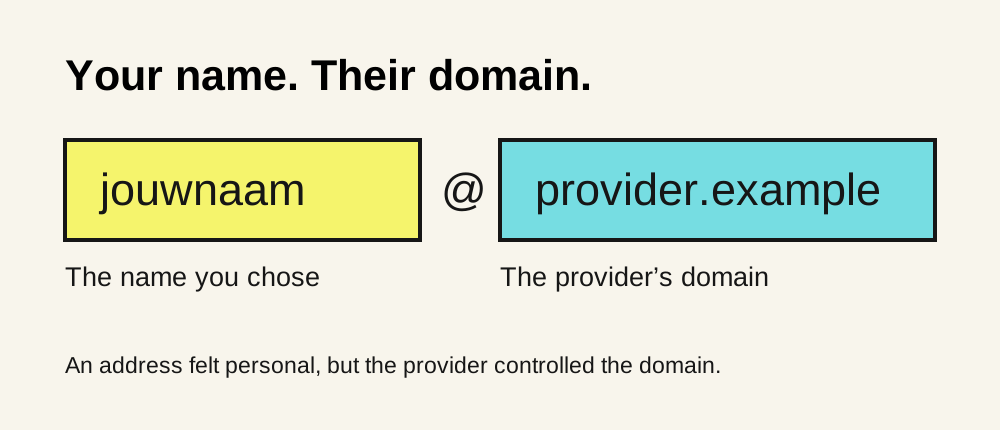
For many Dutch internet users, that first address came from the company supplying their connection. After the @ symbol might be xs4all.nl, planet.nl, hetnet.nl or worldonline.nl.
You chose a name, provided it was still available: your surname, your initials or a nickname. Sometimes it was a family address, with one mailbox for everyone using the computer at home.
That created an unusual mixture. A business appointment for Dad sat between a forwarded joke for Mum and a message from a school friend. Whoever collected the mail could see whether anything had arrived for someone else.
The address felt like your own. You accepted the name after the @ symbol as part of the internet package.
Only much later did you discover how much that second part mattered.
Collecting mail was something you did
Email did not always appear automatically. You opened a program such as Eudora, Outlook Express or Netscape Messenger and clicked a button to collect new messages.
A short wait. Perhaps another password. Then new lines appeared in your inbox.
With the widely used POP3 protocol, messages were typically downloaded to the computer and then removed from the mail server, depending on the settings. Your correspondence could therefore live mainly on that one machine. Your provider’s mailbox and the archive on your hard drive were not necessarily the same thing.
That was convenient while everything worked. But a new computer raised another question: how would you take the old mail with you?
The address book had to be exported. Somewhere there were files containing your messages. You simply did not know exactly where. A helpful acquaintance took a look while you hoped the last few years of mail would survive.
Setting up an internet subscription was one thing. Bringing your digital life along was another.

The mailbox was full
Storage was not something you could take for granted either.
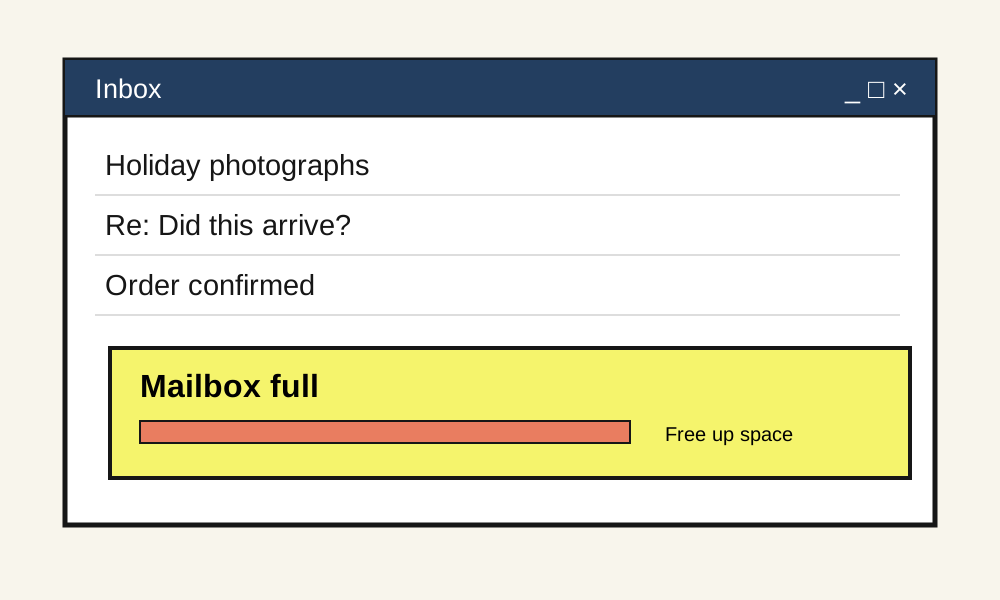
By later standards, early mailboxes often offered little space. The exact limit varied by provider and subscription, but a few large attachments could use a substantial share.
A batch of holiday photographs was not just a pleasure. It could be a problem, particularly if someone sent the original files without reducing their size.
A full mailbox could cause incoming messages to be rejected. The sender received an error message while you might remain unaware of anything wrong.
So you started clearing things out.
Old newsletters could go. Forwarded jokes too. But you wanted to keep that long email from a friend, and perhaps the confirmation of an order as well.
Sometimes deleting was not enough: messages remained in the trash. Or your email program left copies on the server, so tidying your local folders changed little there.
The electronic letterbox that had seemed so modern needed ordinary housekeeping.
An address that spread further and further
At first, only a handful of people knew your email address. Then things moved quickly.
You used it for an order, a newsletter, a forum. It appeared on your CV and beneath your business correspondence. A club added it to its membership records. Relatives saved it in their address books.
Later, the same address became a username for all kinds of services. Password recovery went through that mailbox. Confirmations arrived there.
Something included with a subscription had become a permanent part of daily life.
You could create a new address, but that did not replace the old one. By then, it existed in dozens of places you could not see.
Changing providers meant changing your address
Another provider offered a faster connection or a more attractive subscription. Perhaps you were moving house. Perhaps you were unhappy with the helpdesk.
Technically, the switch seemed manageable: another connection, different equipment, new settings.
But what about your email address?
A provider address belonged to that company’s domain. Another internet provider could not simply take it over. Whether you could keep using it after cancelling, and on what terms, depended on the company.
That was where the puzzle began.
Who needed to know? Which accounts used the old address? Could messages be forwarded for a while? How long would the mailbox remain available?
You sent a circular email with an urgent request:
Please delete my old address and use this one from now on.
Some people updated their address books immediately. Others replied to an old conversation six months later.
The difficult contacts were precisely those who rarely emailed: a former colleague, a distant cousin, someone you had once made arrangements with and who might unexpectedly get in touch again.
You could never be completely sure that everyone had moved with you.
Hotmail offered a way out
Not every first email address came from an internet provider. Free webmail offered another route early on.
Hotmail launched on 4 July 1996. You could use it in a browser, without its address belonging to the company supplying your internet connection. Microsoft acquired Hotmail at the end of 1997.
That made an important difference. You could change internet providers and keep the same webmail address.
Some people made Hotmail their main address. Others kept their provider address for serious correspondence and created a second mailbox for websites, newsletters and contacts they preferred to keep separate.
Expectations about storage changed too. On 1 April 2004, Google announced a preview version of Gmail with one gigabyte of free space, a strikingly generous offer at the time.
Constantly choosing which messages to delete suddenly seemed less inevitable.
The old address lived on
Yet provider addresses did not disappear.
People who had used an address for years often had little desire to start again. Everything already arrived there. Everyone knew it. Why change?
That value can also be seen in separate email subscriptions. KPN, for example, offers an E-mail Only subscription allowing customers to retain their KPN mail after cancelling their internet connection.
The former extra had acquired a value of its own. You no longer paid for internet access through that provider, but to remain reachable at the same address.
An old email address could feel familiar too. It belonged to your first computer, your first job with internet access, the years when your children still lived at home. The mailbox held messages from people you rarely spoke to anymore — or from whom no new message would ever arrive.
A small piece of yourself
An email address consists of little more than a name, an @ symbol and a domain. Over time, though, an entire life becomes attached to it.
Job applications arrived there. Holiday plans. Good news and bad news. The first messages from someone who would become important.
Not everyone kept that correspondence. Computers failed, archives went missing and mailboxes closed. Sometimes only the address remained.
That was what made switching so awkward. You were changing suppliers, but also had to make sure people could still find you.
Your first email address began as a line in an internet provider’s welcome letter.
A few years later, it was too important to lose.
Sources
Historical and technical references; current provider information checked on 3 October 2026.