The Web gets a face
Not the first, but the breakthrough
Graphical web browsers already existed when NCSA Mosaic appeared in early 1993. WorldWideWeb ran on NeXT computers; Erwise, ViolaWWW and Midas likewise offered windows, mouse control and formatted text. Mosaic did not invent the graphical Web.
Its importance lay in the combination. The browser was relatively easy to install, responded to the mouse in familiar ways and placed images directly between paragraphs. Marc Andreessen and Eric Bina built the first version at the National Center for Supercomputing Applications (NCSA) at the University of Illinois. Other staff then helped bring it to more kinds of computer.
A photograph among the words
That sounds like a small difference because every modern site mixes words and pictures. In 1993 it transformed the experience. A title, explanation, map, scientific illustration and photograph could form a single document. Readers no longer had to reconstruct the relationship between text and separate files themselves.
The page contained a link to an image. The picture appeared after another action, often in a separate window.
The browser placed the image at the point selected by the document's author.
The new <img> capability gave authors a powerful tool. The Web became not only easier to read but more enticing. A click could suddenly lead to an illustrated museum object, a map or a photograph of someone on the other side of the world.
The browser that reached ordinary computers
The first public alpha of Mosaic for X appeared in February 1993. X mainly ran on Unix workstations and was not yet a living-room platform. By September, according to the W3C's historical timeline, working versions also existed for Windows PCs and the Macintosh. The same web world could now appear on many more desks.
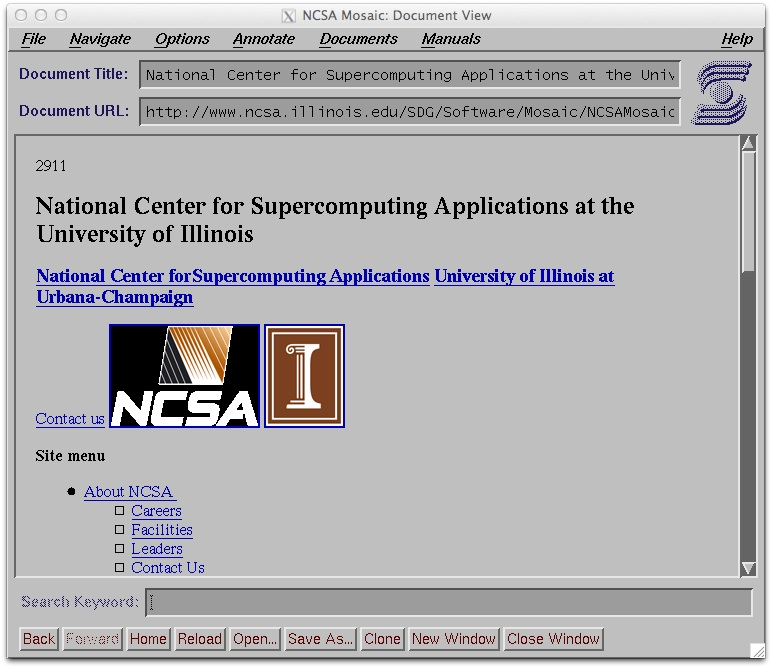
Mosaic offered recognisable buttons for moving back, moving forward, going home, reloading, opening and saving. A user could type an address without understanding the network commands underneath. The browser did not make the technology invisible, but it made it manageable.
The Web grows faster than its tools
Mosaic arrived at precisely the right time. In April 1993 CERN made the Web's core technology freely available. The W3C timeline then records a sudden acceleration: in March, web traffic represented about 0.1 per cent of traffic on the NSF backbone; by September it was 1 per cent. More than two hundred web servers were known in October.
The first public alpha of Mosaic for X appears.
Working versions exist for Unix, Windows and Macintosh.
The Web has more than two hundred known servers.
Newspapers and magazines report on Mosaic and the Web.
The browser and the Web reinforced each other. More users made opening a website worthwhile; more sites gave people a reason to install Mosaic. The word surfing began to make sense: visitors no longer followed only a deliberate route but could let a growing world of images carry them along.
Not yet a colourful modern website
The revolution should not be made too beautiful in retrospect. Pages in Mosaic were usually austere. HTML offered headings, paragraphs, lists, forms and images, but no Cascading Style Sheets. Authors had little control over fonts, margins or exact positioning. The browser determined much of the presentation.
That is exactly why early sites were so recognisable: a grey browser frame, white page, black text, blue underlined links and the occasional small image appearing slowly, line by line. Over a modem, that picture might take seconds or minutes to arrive.
Dutch perspective · Amsterdam, 1994
The Digital City becomes clickable
De Digitale Stad — the Digital City — opened on 15 January 1994 as a text environment. Residents selected numbered menus, used cursor keys and visited squares, buildings and cafés through a terminal. The urban metaphor mainly existed in the names.
On 15 October 1994 DDS moved to the World Wide Web. A graphical entrance now existed alongside the text interface. Its own project report called the pictures more attractive and point-and-click control far more intuitive. Mosaic was among the graphical browsers through which such an environment could be viewed.
DE DIGITALE STAD
Amsterdam · gateway to the electronic highway
Stylised reconstruction · not an original screenshotThe transition also had a cost. According to DDS, users sometimes still had to return to the text interface through Telnet in order to talk, send mail, enter the café or visit the Metro. The graphical Web was good at displaying documents, but not yet at all the live communication a digital city required.
Read the historical DDS project report ↗From Mosaic to Netscape
Success inevitably produced a next step. In March 1994 Andreessen and several colleagues left NCSA to found a commercial browser company with entrepreneur Jim Clark. It was briefly called Mosaic Communications, but the Mosaic name belonged to NCSA. The business continued as Netscape Communications.
Mosaic thus became the hinge between two web eras. It began as an academic tool, showed a large audience what a graphical Web could be, and supplied the people and ideas for the browser that would dominate the middle of the 1990s.
In the next chapter, Netscape Navigator conquers the internet. The browser becomes faster, more commercial and increasingly decisive in what web authors dare to build.