The browser that started the Web
One name for the program and the new medium
When Tim Berners-Lee built his first web browser in 1990, there was no browser market and no public Web. He therefore gave the program the same name as the system it revealed: WorldWideWeb. The browser was later renamed Nexus to avoid confusion with the World Wide Web as a whole.
That distinction feels obvious today. We do not call Chrome or Firefox ‘the Web’. In 1990, however, the browser, server, addressing system, HTML and HTTP were components of one experiment. Berners-Lee had to design the window and determine what could be viewed and changed through it at the same time.
Why a NeXT computer?
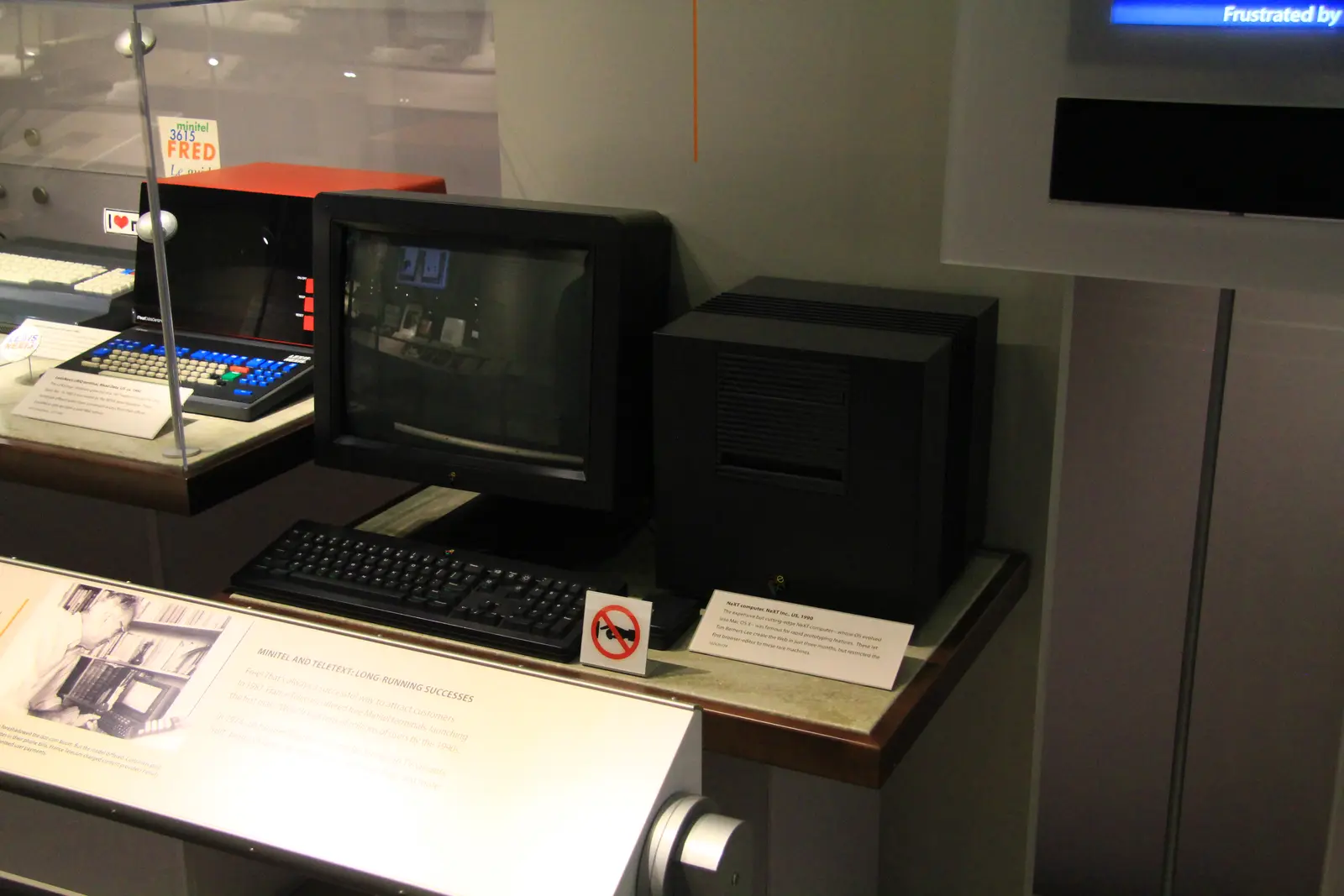
Berners-Lee gained access to a NeXT computer at CERN in September 1990. These black workstations were expensive and uncommon, but their NeXTStep operating system offered unusually effective tools for building graphical applications quickly. Windows, menus, multiple fonts and editable text did not have to be programmed from scratch.
NeXTStep's existing text component could be extended with hypertext. According to Berners-Lee, the prototype worked as a browser after about a month and as an editor a month later. By Christmas 1990, the core of the Web existed as a working system.
A document without a modern address bar
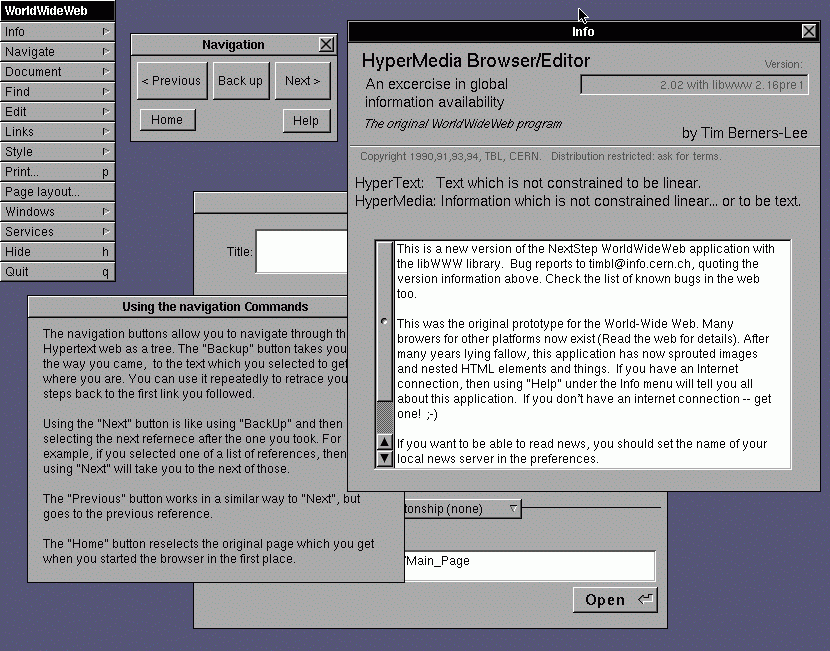
WorldWideWeb did not look like a browser we would recognise today. There was no row of tabs, no combined search and address field, and no home page filled with frequently visited sites. Navigation used menus and separate windows. Buttons such as Previous, Back up, Next and Home helped users move through link history and document structure.
The browser could display text in different fonts, sizes and alignments. The original 1990 version was greyscale and displayed images in separate windows. The familiar colour image below shows a later version from 1993, after the program had been extended. It is not an exact snapshot of the first December release.
Creating a link without typing HTML
The most forward-looking feature was not browsing, but editing. A user could format text directly, create a new document and add a reference without typing angled HTML tags or memorising a web address. The document on screen was both the page being read and the page being edited.
Open the target page and record where the new reference should lead.
Return to the document and choose the text that should become clickable.
Use the Links menu to connect the selected words to the destination.
This worked more like a word processor than the later combination of browser, content management system and code editor. Berners-Lee wanted people not only to receive information but also to add new nodes to the Web with ease. The early Web was designed as a collaborative space.
Surprisingly modern ideas
WorldWideWeb looks austere, yet it contained ideas that only became common much later, or have recently returned. The program used a form of styles to present documents and could handle links to graphics, sound and moving images alongside text. Most importantly, its interface tried to hide the technical components.
Links could be selected with a mouse instead of through commands.
Text was edited in a form that closely resembled the resulting document.
The browser used style information to determine how document elements appeared.
The NeXTStep environment could open several types of linked media.
Why did this browser not conquer the world?
NeXTStep's strength was also its greatest limitation. Few NeXT computers existed outside specialist institutions. WorldWideWeb could not simply be installed on the PCs, Macintoshes or Unix workstations used elsewhere. The Web needed separate, portable browsers if it was to spread.
Nicola Pellow's Line Mode Browser made web pages readable on many more systems, but it lost the graphical editor. Other early browsers for Unix and Windows likewise became programs mainly for viewing. When Mosaic introduced the Web to a much larger audience in 1993, the browser increasingly became a consumption tool. Page creation usually happened somewhere else.
Dutch perspective · 1992
The Netherlands mainly watched through text
When Nikhef opened the first Dutch website in February 1992, WorldWideWeb was not a practical public browser because it required a NeXT computer. Dutch pioneers instead joined the portable Web. The Line Mode Browser allowed researchers to browse information on nic.nikhef.nl from ordinary terminals.
The contrast is revealing. WorldWideWeb demonstrated how rich and editable the Web might become; the text browser allowed the Web to travel. The Netherlands encountered the second quality first.
An ideal that never entirely disappeared
The separation between viewing and editing shaped the Web for decades. Most people read pages in a browser and published through complicated management systems. Blogs, wikis, shared documents and visual site builders partly restored the original ideal: opening, changing and sharing from almost the same environment.
WorldWideWeb was therefore more than a primitive ancestor of Chrome. In one important respect, it was more ambitious. The first browser treated every user as a potential author.
The next chapter introduces Mosaic. It made the Web visible and appealing to many more people — but also confirmed that browsing mostly meant looking and clicking.