From start-up to web standard
A second attempt, this time as a company
After Mosaic, Marc Andreessen and entrepreneur Jim Clark saw that the browser could become more than an academic tool. They founded Mosaic Communications in California in the spring of 1994. The name caused a dispute with the University of Illinois, owner of NCSA Mosaic, and the company became Netscape Communications in November.
Meanwhile, the team was building an entirely new browser at great speed. Its internal name was Mozilla, a contraction that roughly meant ‘Mosaic killer’. Andreessen announced the first beta on 13 October 1994. The commercial release of Netscape Navigator 1.0 followed on 15 December.
Jim Clark, Marc Andreessen and a young development team begin again.
The browser codenamed Mozilla can be downloaded and tested.
Company and browser move away from the Mosaic trademark.
The first commercial release appears for the major computer systems.
Waiting became less empty
The Web remained slow over a modem. Netscape could not make the telephone line faster, but it changed how that slowness felt. Navigator began displaying a page while the rest was still arriving. Text became readable before every picture had finished. Users spent less time looking at a blank window.
Mozilla documentation names display-while-loading as one of the features through which Netscape set the pattern. The gain was not just seconds but control: you could begin reading, choose a link or decide not to wait for the large photograph.
Download, copy, pass it on
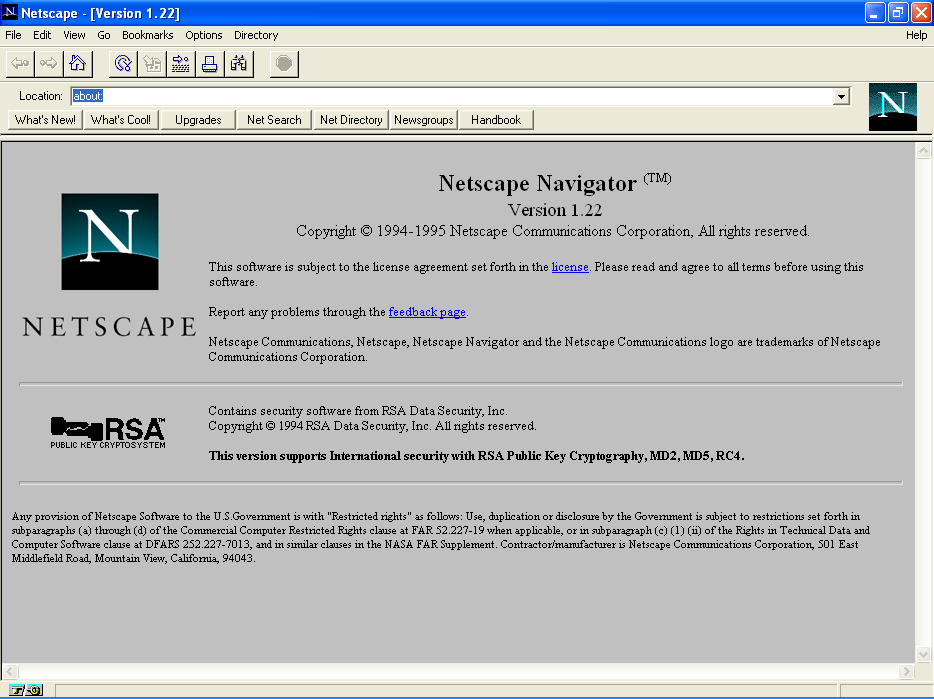
Navigator ran on Windows, Macintosh and Unix. Non-commercial use was initially free and test versions could be taken directly from the internet. Netscape pursued two tracks at once: the browser spread cheaply, while businesses paid for commercial licences, support and server software.
People without a fast internet connection could also obtain the browser through an access provider, computer shop, magazine or installation disk. Netscape travelled simultaneously through the network and through the tangible world of floppy disks and CD-ROMs.
The US court in the Microsoft case later found that Navigator's usage share exceeded eighty per cent in late 1995 and early 1996.
That dominance arrived at extraordinary speed. A program officially released at the end of 1994 looked like the de facto standard a year later. Web authors tested in Netscape first; some sites even told visitors to install the browser before continuing.
The browser becomes a platform
Netscape wanted to do more than display documents. The browser should become an environment in which sites could remember, calculate, secure and play things. Many technologies now invisibly woven into the Web reached their first large audience through Navigator.
A site could retain small pieces of data, for example for a shopping basket or logged-in session.
An encrypted connection made it possible to send sensitive data more securely.
Navigator 2.0 brought programs to the page in 1995: forms could react and windows could move.
Netscape's plug-in architecture allowed external programs to play new media inside the browser window.
These innovations served different needs. Cookies helped a stateless Web recognise a user between clicks. SSL supported trust in online trade. JavaScript, developed at Netscape by Brendan Eich, turned the page into something that could respond while being viewed. The browser began to resemble a small operating system.
Every new button cast a shadow
Netscape also added its own HTML extensions. Tables, frames, font settings, centred text and even blinking words gave authors greater control. But if another browser did not understand an extension, a page could look different or become unusable.
A seductive feedback loop emerged. The more people used Netscape, the more attractive it became to design for Netscape. And the more sites required Netscape features, the stronger the pressure on visitors to choose that browser. The browser was no longer merely a neutral window; it began helping to determine the language behind the Web.
Dutch perspective · De Digitale Stad, 1995
DDS knowingly takes the risk
De Digitale Stad wanted to build a richer graphical environment for version 3.0. At precisely that moment a new Netscape beta appeared with tables, client pull and server push. These features could improve the map layout and refresh pages automatically.
The project team understood the compatibility problem. Other browsers did not yet support the new commands and nobody knew how many future visitors would use Netscape. Yet recent DDS statistics, according to its historical project report, showed that most graphical visitors already arrived with Netscape. Because the browser was free for private users, DDS could recommend it as well.
More control over maps, functions and the position of elements on screen.
Tables and automatically refreshing pages offered abilities still missing from standard HTML.
DDS chose progress, but made the experience more dependent on one browser.
This Dutch example shows exactly how Netscape built its power: not through a formal decision declaring Navigator the standard, but through thousands of practical decisions by web authors who wanted to make something new right now.
Read the decision in the historical DDS project report ↗A browser disk with a border
The installation disk below looks like an ordinary software product, but the words US and Canada — Not For Export tell a larger story. Strong encryption software was covered by United States export controls. Navigator 1.1 therefore existed in versions that could not simply be distributed beyond the United States and Canada.
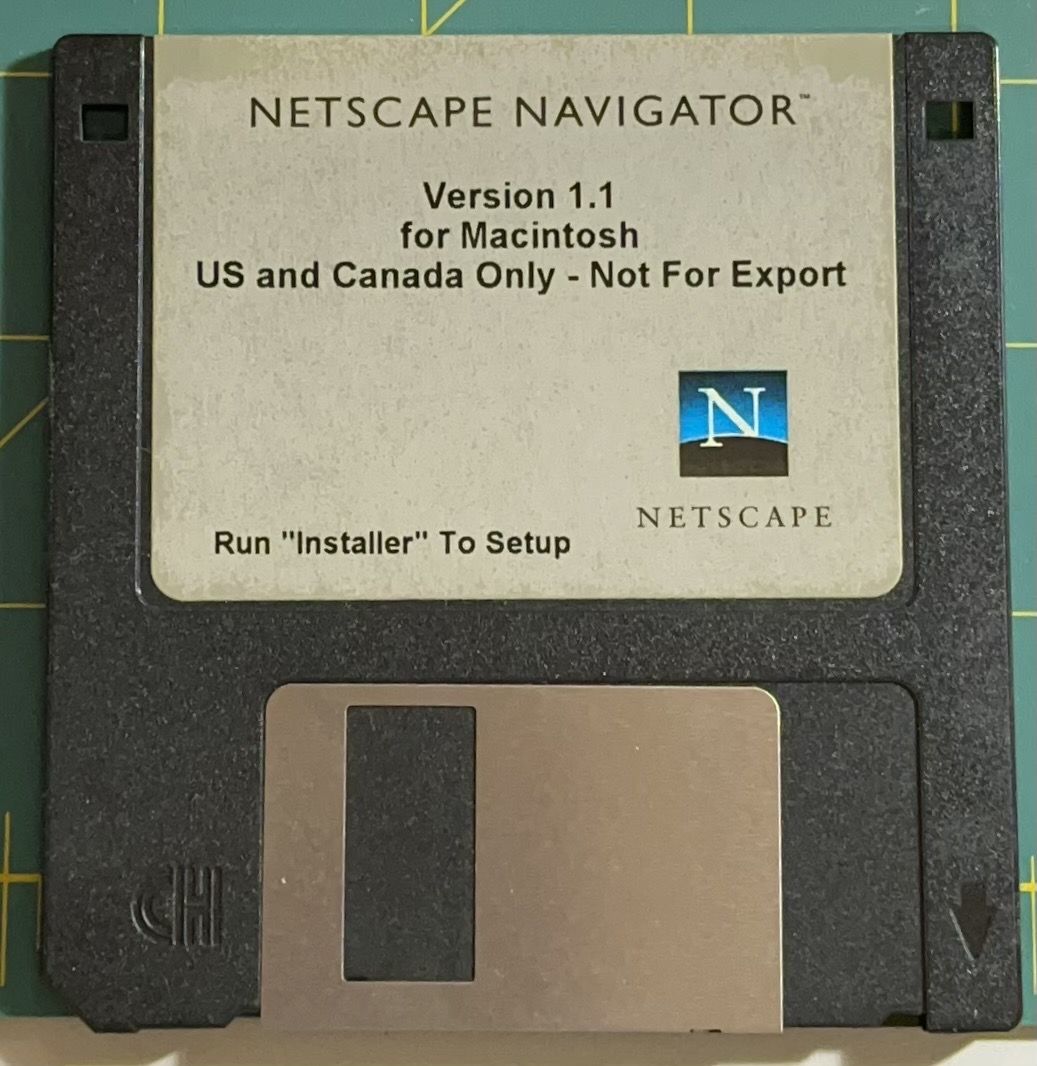
The secure Web was therefore more than a technical design problem. National rules determined which browser could carry which protection. At the same time, Netscape made the padlock and the idea of a secure session familiar to a growing public.
Too successful to ignore
In May 1995 Bill Gates warned his executives that Netscape, with a usage share of about seventy per cent, could determine which network extensions would catch on. His concern went beyond competition over one program. Because Navigator ran across operating systems and could execute web programs, the browser threatened to become an independent layer above Windows.
That was Netscape's greatest victory and the beginning of its most dangerous contest. Microsoft could no longer treat the Web as a side issue. In the next chapter, Internet Explorer arrives with Windows — and browser distribution becomes an instrument of power.